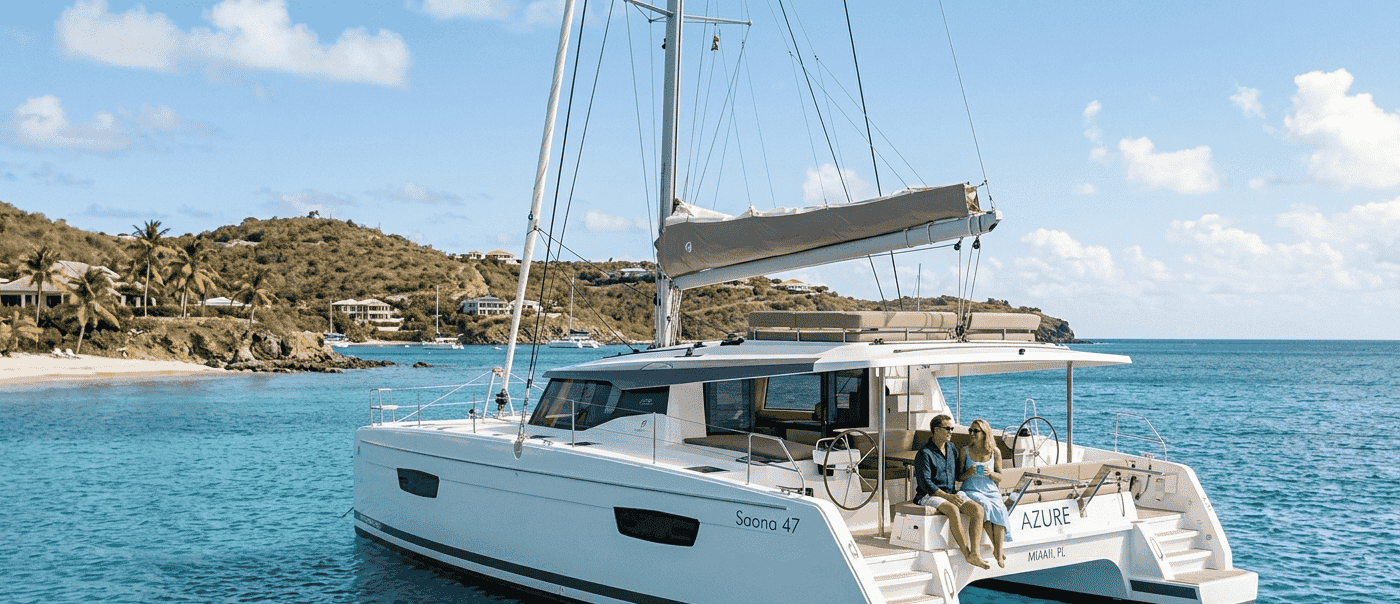
How do you finance a catamaran? Most buyers use a secured marine loan, sometimes called a yacht mortgage, that uses the boat itself as collateral. In 2026, these loans commonly run 6.5 to 9.5 percent APR, with 15 to 20 percent down for vessels under about $1 million and 25 to 30 percent down for larger yachts, over terms of 10 to 20 years. Beyond a standard marine loan, catamaran buyers have two paths that other boat buyers rarely use as heavily: home equity financing, and charter management ownership programs that offset costs with rental income. Which one fits depends on the boat’s price, your financial picture, and how much you plan to use it yourself.
Key takeaways
- Marine loan rates in 2026 run roughly 6.5 to 9.5 percent APR, meaningfully higher than the 4.5 to 5 percent still quoted on several older catamaran financing pages.
- Lenders typically want 15 to 20 percent down on catamarans under $1 million, rising to 25 to 30 percent on larger vessels, a credit score of 700 or higher, and debt to income under roughly 35 to 45 percent.
- Production catamarans from high volume builders are easier to finance than custom or rare boats, because lenders need comparable sales to establish value.
- Charter management programs, common specifically for cruising catamarans, can offset ownership cost through rental income, but lenders will not count that income when qualifying you for the loan.
- A 2025 federal tax law may allow 100 percent first year depreciation for a catamaran placed into genuine charter business use, a significant and fairly new benefit that requires a CPA’s guidance to use correctly.
Why catamaran financing is its own category
Catamarans cost meaningfully more than a monohull of the same length, since you’re financing two hulls, more beam, and generally more interior volume. New cruising catamarans from major builders commonly start in the $400,000 to $600,000 range for smaller models and climb well past $1 million for larger ones, with used catamarans available across a much wider range depending on age and condition. That price point pushes most buyers out of standard personal loan territory and into specialized marine lending, real estate backed borrowing, or a business ownership structure entirely.
The core financing paths
1. A secured marine loan (the standard path)
This works like a mortgage for the boat: the lender holds a lien against the vessel, and in return offers a lower rate than an unsecured loan would carry.
What lenders typically want in 2026:
| Factor | Typical requirement |
|---|---|
| Down payment | 15 to 20 percent under about $1 million; 25 to 30 percent above that |
| Credit score | 700 or higher for the best rates; some lenders work with 650 plus with a larger down payment |
| Debt to income ratio | Generally under 35 to 45 percent, depending on the lender |
| Loan term | 10 to 20 years, generally longer for newer, higher value boats |
| Interest rate range | Roughly 6.5 to 9.5 percent APR for well qualified borrowers, into the low teens for weaker credit |
| Loan to value | Commonly up to 80 to 85 percent |
A worked example: a $500,000 catamaran financed at 80 percent LTV means $100,000 down and a $400,000 loan. At 7.5 percent over 15 years, that’s roughly $3,710 a month and close to $268,000 in total interest over the life of the loan. Run your own numbers through a marine loan calculator before you shop, since the term length changes total cost significantly, a longer term lowers the payment but raises what you pay overall.
New versus used, and production versus custom. According to marine lending specialists, production boats from high volume, well established builders such as Fountaine Pajot or similar brands are the easiest to finance, because lenders can point to comparable sales to justify the loan amount. Custom or very low production catamarans are harder to finance for exactly the opposite reason, there’s little comparable sales data for a lender to lean on. Most lenders cap financing around vessels 20 years old or newer, though some will go further with a strong borrower and enough supporting documentation on the boat’s condition and value.
2. Home equity loan or HELOC
If you own a home with meaningful equity, this route frequently beats a standard marine loan on rate, since it’s underwritten against your home rather than a depreciating boat. The tradeoff is real: your home, not the catamaran, becomes the collateral, so missed payments carry a much higher personal risk. This is a genuinely common path among experienced catamaran buyers specifically because of the rate advantage.
3. Investment or securities backed loan
If you hold a substantial investment portfolio, some lenders will let those assets serve as collateral for a loan, avoiding a deep dive into personal income documentation. This keeps your portfolio invested rather than liquidated, but carries the risk that a market downturn could trigger a margin style call on the loan, so it suits investors who understand and accept that risk.
4. Cash
Paying cash removes financing risk entirely and can strengthen your negotiating position with a seller. Experienced buyers who go this route commonly recommend still keeping a healthy reserve, often cited around twelve months of expenses, rather than putting every available dollar into the purchase.
5. Seller financing (rare)
True seller financing on a catamaran is uncommon, since unlike real estate, boats are mobile and can leave the country. One narrow exception exists through IRS approved 501(c)(3) charities that accept donated boats and resell them with financing attached, typically requiring around 40 percent down over a 3 to 5 year term. Selection through this channel is limited, often to boats that were hard to sell conventionally, so treat it as a last resort rather than a primary strategy.
The charter management path: unique to catamarans
This is the option most general boat financing content skips entirely, and it’s genuinely more relevant to catamarans than to almost any other vessel type, because cruising catamarans are in especially high demand across the global charter industry.
How it works. Companies such as Dream Yacht Charter, Navigare Yachting, and The Moorings or Sunsail run managed ownership programs. You purchase the catamaran, place it into their charter fleet, and the company markets and manages charter bookings on your behalf. In exchange, you typically receive either a share of charter revenue or a guaranteed income arrangement, along with personal use of the boat for a set number of weeks each year, and the management company handles maintenance and operations.
What it changes financially. Charter income can meaningfully offset your ownership costs, sometimes covering a large share of the loan payment, insurance, and maintenance, depending on the boat, the location, and the specific program’s terms. But there’s an important lending detail almost nobody mentions clearly: marine lenders generally will not count projected charter income when qualifying you for the loan itself. You need to demonstrate you can carry the full loan payment from your own income and assets, independent of whatever the charter program might bring in. Charter yacht financing is also frequently harder to arrange than a purely private, non-charter loan, so if this is your plan, discuss it with your lender and broker before you commit to a specific boat.
The tax picture: two separate benefits, handled very differently
Second home mortgage interest deduction
If your catamaran has sleeping accommodations, a permanent cooking facility, and a toilet, it can potentially qualify as a second home for federal tax purposes, which may make the loan interest deductible if you itemize and don’t already have this deduction claimed on another second home. This has been a long standing, well established rule. Confirm your specific situation with a tax professional, since itemizing thresholds and other personal factors affect whether this actually benefits you.
Business use depreciation (new and significant, but requires real compliance)
If a catamaran is placed into genuine, documented charter business use, a federal tax law passed in 2025 may allow a substantial first year depreciation benefit. Multiple 2025 and 2026 marine tax and brokerage sources describe 100 percent bonus depreciation as restored permanently for qualifying business property acquired and placed in service after January 19, 2025, reversing what had been a scheduled phase down toward 20 percent by 2026 under the prior law. Some older marketing pages in this exact niche still describe the old phase down schedule as current, which shows how quickly this specific area has moved and how easily it goes stale in content.
This benefit comes with real requirements, not just paperwork:
- The boat generally must be used more than 50 percent of the time for qualified business activity each year.
- Ownership typically needs to run through a legitimate business entity, such as an LLC or S corp.
- The operation needs to look like a genuine business, not a hobby, meaning real marketing, licensed crew where applicable, proper commercial insurance, and actual profit and loss records.
- Selling the boat later can trigger depreciation recapture, meaning some or all of what you deducted becomes taxable income in the year you sell.
Given how much money is potentially at stake, and given that even specialized marine tax and brokerage content disagrees on the current rules, this is not an area to rely on a blog post for, mine included. Work with a CPA who specifically handles marine or charter business taxation before you structure a purchase around this benefit.
Documentation and ownership structure
Larger catamarans are commonly documented with the U.S. Coast Guard rather than simply state titled, which allows a lender to record a Preferred Ship Mortgage, a federal lien that gives the lender stronger legal standing than a typical state title lien would. Many buyers, particularly those financing through a business or charter structure, purchase the boat through an LLC or trust rather than as an individual. This affects liability, taxation, and sometimes financing terms, so discuss the right structure for your situation with both your lender and an attorney or CPA before closing.
Step by step: financing a catamaran purchase
- Check your credit and pay down revolving balances. Lenders weight FICO scores heavily, and keeping credit card balances under roughly half of your available limit for several weeks before applying can measurably improve your score.
- Get pre-qualified before you shop. This costs nothing, doesn’t require a hard credit pull at the pre-qualification stage, and tells you your real budget before you fall for a boat outside it.
- Decide your financing path. Marine loan, home equity, investment backed, cash, or a charter ownership structure, based on the guidance above.
- Work with a broker who knows marine lenders. Many lenders who claim to do yacht loans rarely actually close them, and an experienced broker or catamaran specialist can point you toward lenders who genuinely compete for this business.
- Get pre-approved, then shop with confidence. A pre-approval in hand strengthens your negotiating position with sellers.
- Budget for a marine survey. Nearly every marine lender requires a condition and valuation survey before final approval, and this is a real out of pocket cost you should plan for separately from your down payment.
- Finalize documentation, title or Coast Guard registration, and insurance naming the lender as loss payee before closing.
Common mistakes to avoid
- Assuming the rates you see on an older article are current. Marine lending rates move with broader interest rate cycles, and a rate quoted even two or three years ago can be meaningfully out of date.
- Counting on charter income to qualify for the loan. Lenders evaluate your independent ability to pay, not projected rental income.
- Choosing a rare or custom catamaran without checking financeability first. A boat that’s hard to value is a boat that’s hard to finance, regardless of how much you love it.
- Assuming bonus depreciation applies automatically. It requires a genuine, documented business operation, not simply occasional chartering on the side.
- Skipping a pre-approval and shopping on assumed budget. This is how buyers end up qualifying for half of what they expected, after they’ve already fallen for a boat.
FAQs
Generally 700 or higher for the best available rates, though some lenders will work with scores as low as roughly 650 given a larger down payment.
Commonly 15 to 20 percent for vessels under about $1 million, rising to 25 to 30 percent for larger yachts.
Not inherently, but production catamarans from established builders are easier to finance than custom or low volume boats of either hull type, since lenders lean on comparable sales data to value the loan.
No. Lenders generally require you to demonstrate you can carry the loan from your own income and assets, independent of any charter income you expect to receive.
Potentially, as a second home mortgage interest deduction, if the boat has sleeping, cooking, and toilet facilities and you itemize deductions. Confirm your specific eligibility with a tax professional.
Only if it’s placed into genuine, documented business use, such as a real charter operation, meeting the business use threshold and other IRS requirements. This is a complex area with real compliance obligations, and requires guidance from a CPA experienced in marine or charter taxation.
A private loan is qualified purely on your personal finances. A charter managed boat still needs to be qualified the same way for lending purposes, but afterward, charter revenue can help offset your ongoing costs, and the management company typically handles marketing, bookings, and maintenance in exchange for a share of revenue or a management fee.
Commonly 10 to 20 years, with longer terms generally available for newer, higher value vessels and shorter terms typical for older used boats.
A HELOC often carries a lower rate since it’s secured by your home rather than a depreciating boat, but it puts your home at risk if you can’t make payments. A marine loan keeps the risk contained to the boat itself. The right choice depends on your risk tolerance and your home equity position.
Bottom line
Start by getting pre-qualified so you know your real budget, then match your financing path to your situation: a standard marine loan for most buyers, home equity if you have it and want a better rate, and a charter management program if you’re comfortable with a business style ownership structure and want rental income to help offset costs. Whatever path you choose, verify current rates directly with lenders rather than trusting older published figures, and if the business depreciation benefit is part of your plan, get a CPA involved before you buy, not after.
This is general information, not financial, legal, or tax advice. Rates, terms, and tax law change, and this content should be verified against current sources before you rely on it for a purchase decision.