
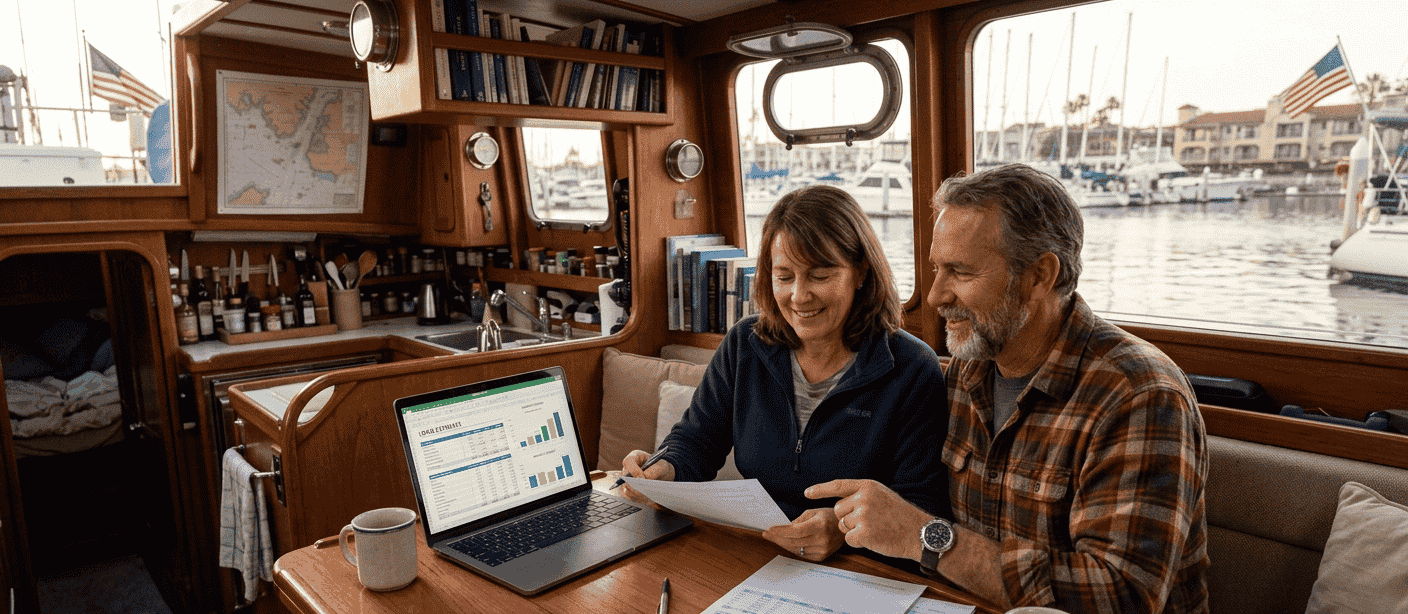
How do you finance a liveaboard boat? It’s genuinely harder than financing a boat for recreational use, and it helps to understand why before you start applying. Many marine lenders explicitly decline to finance a boat that will serve as your primary residence, treating it as a higher risk category than recreational boating. Your realistic paths are a liveaboard friendly marine lender or local finance broker, a home equity loan or HELOC if you own property, an unsecured personal loan, or cash. Each comes with real tradeoffs, and one of them quietly affects your taxes later.
Key takeaways
- Some major marine lenders decline liveaboard applications outright. Trident Funding, one of the largest names in the space, states this directly on its own site.
- Lenders draw this line because full time residence changes the risk profile of the loan, not because of any rule against liveaboard life itself.
- A local marine finance broker or credit union with direct liveaboard experience will usually get you further than a large national lender.
- Liveaboard insurance commonly runs $150 to $400 a month, well above standard recreational boat coverage, and some insurers require documented boating experience or training first.
- A liveaboard boat can qualify as your main home, not just a second home, for the mortgage interest deduction, but only if the loan is secured by the boat itself. An unsecured personal loan does not qualify.
Why liveaboard financing is genuinely different
A recreational boat sits in your risk profile the way a car or a vacation property does. A liveaboard boat sits closer to your actual home, and that changes everything from a lender’s perspective. Full time residence means more wear, more complex insurance requirements, and a borrower whose entire housing situation depends on one asset holding its value and staying insurable. Some lenders simply decline the category rather than underwrite it. Others will do it, but with tighter terms, a larger down payment, or a more thorough look at your finances than a standard recreational boat loan would get.
This is not a judgment on liveaboard life itself. It’s a straightforward risk calculation, the same kind that makes manufactured home loans, for example, look different from conventional mortgages.
The honesty problem, and what to do instead
If you search for this topic, you’ll run into forum advice suggesting you simply tell a lender you’ll keep your house and use the boat recreationally, then move aboard later once the loan closes. I’m not going to repeat that as a strategy. Deliberately misrepresenting your intended use on a loan application is a real legal exposure, not a clever workaround, and marine lenders exist specifically because some of them are comfortable underwriting liveaboard use honestly.
The better path is finding a lender who will actually say yes to the truth. That usually means a smaller, specialized marine finance broker rather than a large national lender, a credit union with a marine lending program in a region with a strong liveaboard culture, or a lender your broker or marina community can point you to directly. Liveaboard sailing and trawler forums, and organizations built around this lifestyle, are genuinely useful here, not for workarounds, but for names of lenders who have actually closed these loans before.
Your realistic financing paths
1. A liveaboard friendly marine lender or broker
These exist, they’re just less visible than the large national marine lenders who publicly decline the category. A broker who works this market regularly will know which of their lending partners currently write liveaboard loans, since this shifts over time as individual banks adjust their risk appetite. Ask directly and early, before you fall in love with a specific boat.
2. Home equity loan or HELOC
If you own property with equity, this is frequently the most accessible route, and often the cheapest, since it’s underwritten against your home rather than a liveaboard classification that makes marine lenders nervous. The obvious tradeoff is that your home, not the boat, becomes the collateral. Some buyers deliberately structure this as a transition step: keep the house through the loan process, then sell it once you’ve moved aboard and use the proceeds to pay down the HELOC.
3. Unsecured personal loan
This works regardless of how you plan to use the boat, since there’s no marine specific underwriting involved at all. The cost is real, though: rates are meaningfully higher than a secured marine loan, commonly landing well above standard boat loan rates, and loan amounts are typically smaller. There’s also a tax consequence worth knowing before you choose this path, covered below.
4. Cash
If you can pay cash, it removes the entire liveaboard lending problem. It’s genuinely the simplest route through this specific obstacle, though it means committing a large sum to a single, depreciating asset. Experienced buyers commonly recommend keeping a solid reserve on top of the purchase price rather than spending every available dollar, since liveaboard maintenance costs are less predictable than housing costs on land.
5. Seller financing
Uncommon, but occasionally available directly from a private seller, particularly for an older boat that’s been hard to sell conventionally. Terms are negotiated individually, so involve an attorney in the paperwork regardless of how informal the arrangement feels.
What it actually costs each month
Realistic all in liveaboard costs, combining loan payment, insurance, slip fees, and maintenance, commonly run $1,500 to $4,000 a month depending on the boat’s size, your location, and whether you’re financing or paying cash. In an expensive coastal city, that can still beat comparable apartment rent. In a lower cost market, the savings are smaller and the appeal shifts more toward lifestyle than pure economics.
| Cost category | Typical monthly range |
|---|---|
| Loan payment (if financed) | Varies widely by boat price and terms |
| Liveaboard insurance | $150 to $400 |
| Slip rent plus liveaboard premium | $100 to $500 premium on top of standard slip rent |
| Maintenance, averaged over the year | $200 to $500 |
| Utilities, pump out, incidentals | Varies by marina |
Budget for at least one unpredictable year where a single repair, an engine overhaul or a hull issue, adds several thousand dollars outside your normal budget. This kind of surprise is more common on a boat you live on full time than one you use occasionally.
Insurance: expect a different conversation than a recreational policy
Liveaboard insurance is a distinct product from standard recreational boat coverage, and it typically costs more because the vessel is occupied full time rather than sitting unused most of the year. If this is your first boat and it’s large enough to live aboard comfortably, some insurers will want to see documented experience or training before they’ll underwrite you, occasionally requiring hours with a licensed skipper before you’re cleared to operate solo. Building some boating experience and taking relevant courses before you buy can genuinely smooth this process. Organizations built around trawler and liveaboard ownership can point you toward insurers who actively write these policies, since not every marine insurer does.
Marina permits, fees, and the honesty issue again
Not every marina allows liveaboards, and many that do cap the number of liveaboard slips, commonly somewhere between 10 and 25 percent of total capacity, with waitlists at popular locations stretching for years. Marinas that permit it typically charge a separate liveaboard fee on top of standard slip rent, commonly $100 to $500 a month, and require proof of insurance meeting specific minimums.
This creates the same honesty issue as lending, in a different form. Someone who moves aboard without declaring it to avoid the fee and the waitlist is sometimes called a sneakaboard in marina circles, and it’s a real risk, not just an informal term. Getting evicted from a slip after quietly moving aboard is a documented, recurring problem in liveaboard communities. Find a marina with an actual liveaboard agreement before you commit to the lifestyle, not after.
The tax angle: this matters more for you than for a typical boat buyer
IRS Publication 936 defines a qualified home broadly enough to include a boat, as long as it has sleeping, cooking, and toilet facilities. Critically, the IRS also confirms you can have only one main home at any time, and that main home is simply the one where you ordinarily live most of the year. For someone who genuinely lives aboard full time, that means the boat can be claimed as your main home for mortgage interest deduction purposes, not merely a second home.
The catch, and it’s an important one. The loan has to be secured by the boat itself for the interest to be deductible. This is exactly where the liveaboard lending problem comes back around: if you end up financing through an unsecured personal loan because no marine lender would write a secured liveaboard loan, you lose this deduction entirely, regardless of how the boat is equipped or how you actually live on it.
Whether it’s worth pursuing at all. For 2026, the standard deduction is $16,100 for single filers and $32,200 for married filing jointly. If you don’t have a land based mortgage or other significant itemized deductions, your boat loan interest alone may not clear the standard deduction, making this benefit theoretical rather than real for some buyers. Run the math both ways, or better yet, have a CPA run it, before assuming this deduction changes your financial picture.
A quick distinction: liveaboard boat versus floating home
These get confused constantly, and they’re financed differently. A liveaboard boat is a vessel, capable of navigation, that you happen to live on. A floating home is a permanently moored structure, connected to fixed utilities, in a defined floating home community, closer in legal character to a manufactured home than to a boat. Floating homes generally cannot get a conventional mortgage either, since they don’t meet standard real estate definitions, and are instead financed through specialty lenders, personal property loans, or a HELOC against land based property, much like a liveaboard boat. If you’re specifically looking at an established floating home community, ask the community directly what financing options its residents actually use, since this varies by location and by whether the community carries any underlying land ownership structure.
Step by step: financing a liveaboard purchase
- Get honest with yourself about the boat type first. Sailboat, trawler, or houseboat all carry different liveaboard practicality, cost, and financing norms.
- Find your insurer before your lender. Confirming you can actually get liveaboard coverage, and what experience requirements apply to you, avoids wasting time on a loan for a boat you can’t insure.
- Talk to a marine finance broker directly about liveaboard use, upfront and honestly. Ask which of their lending relationships currently write these loans.
- Compare that against a HELOC or home equity loan if you own property, since it may beat marine lending on rate even after accounting for the added personal risk.
- Confirm marina availability before you finalize anything. A boat you can’t legally live aboard at any nearby marina isn’t a liveaboard purchase yet, it’s just a boat.
- Budget the full monthly cost, not just the loan payment, using the ranges above as a starting point for your own numbers.
- Talk to a CPA about the mortgage interest deduction before you choose between a secured and unsecured loan, since this decision has a real, quantifiable tax consequence attached to it.
Common mistakes to avoid
- Assuming any marine lender will finance liveaboard use. Several of the largest names in the industry explicitly do not, and finding out after you’ve picked a boat wastes real time.
- Misrepresenting your intended use to get approved. Beyond the legal exposure, it can also mean losing marina liveaboard status and insurance coverage that actually matches how you use the boat.
- Skipping the insurance conversation until after you’ve financed the boat. Confirm you can actually get covered, and understand any experience requirements, before you commit.
- Choosing an unsecured personal loan without understanding the tax tradeoff. It’s often the easiest loan to get, but it forecloses the mortgage interest deduction entirely.
- Moving aboard without a declared liveaboard agreement at your marina. This risks eviction and undermines the insurance and legal standing you actually want as a full time resident.
FAQs
Yes, but not from every lender. Several major marine lenders decline liveaboard applications outright, so you’ll likely need a specialized marine finance broker or a lender with direct liveaboard experience.
Full time residence on a boat carries a different risk profile than recreational use, involving more wear, more complex insurance needs, and a borrower whose housing depends entirely on one asset. Some lenders simply decline to underwrite that category.
Yes, generally. Liveaboard policies commonly run $150 to $400 a month, reflecting full time occupancy, and some insurers require documented boating experience or training before they’ll write a policy for a first time buyer.
Yes, according to IRS Publication 936, if it has sleeping, cooking, and toilet facilities and you genuinely live there most of the year. The loan must be secured by the boat for the interest to be deductible, which is why the type of financing you choose matters beyond just the interest rate.
You keep more flexibility in how you use the loan proceeds, but you lose eligibility for the mortgage interest deduction entirely, since that deduction requires the loan to be secured by the qualified residence.
No. Many prohibit it entirely, and most that allow it cap the number of liveaboard slips and charge a separate liveaboard fee on top of standard slip rent.
Similarly, but not identically. Neither typically qualifies for a conventional mortgage. Both commonly rely on specialty lenders, personal property loans, or home equity financing against land based property you already own.
Realistically $1,500 to $4,000 a month all in, covering any loan payment, insurance, slip and liveaboard fees, and maintenance, depending on the boat and your location.
Bottom line
Liveaboard financing is a real, distinct category, not just a boat loan with extra paperwork. Start with insurance and marina availability before you fall in love with a specific boat, find a lender or broker who will underwrite the truth rather than a workaround, and understand before you choose a loan type that a secured loan protects a real tax benefit that an unsecured one does not. Done honestly, this is a genuinely achievable path to the lifestyle. Done through a workaround, it creates legal and insurance exposure that can cost far more than the friction it was meant to avoid.
This is general information, not financial, legal, insurance, or tax advice. Lender policies, marina rules, and tax law change and vary by location. Confirm current details directly before you commit to a purchase.