
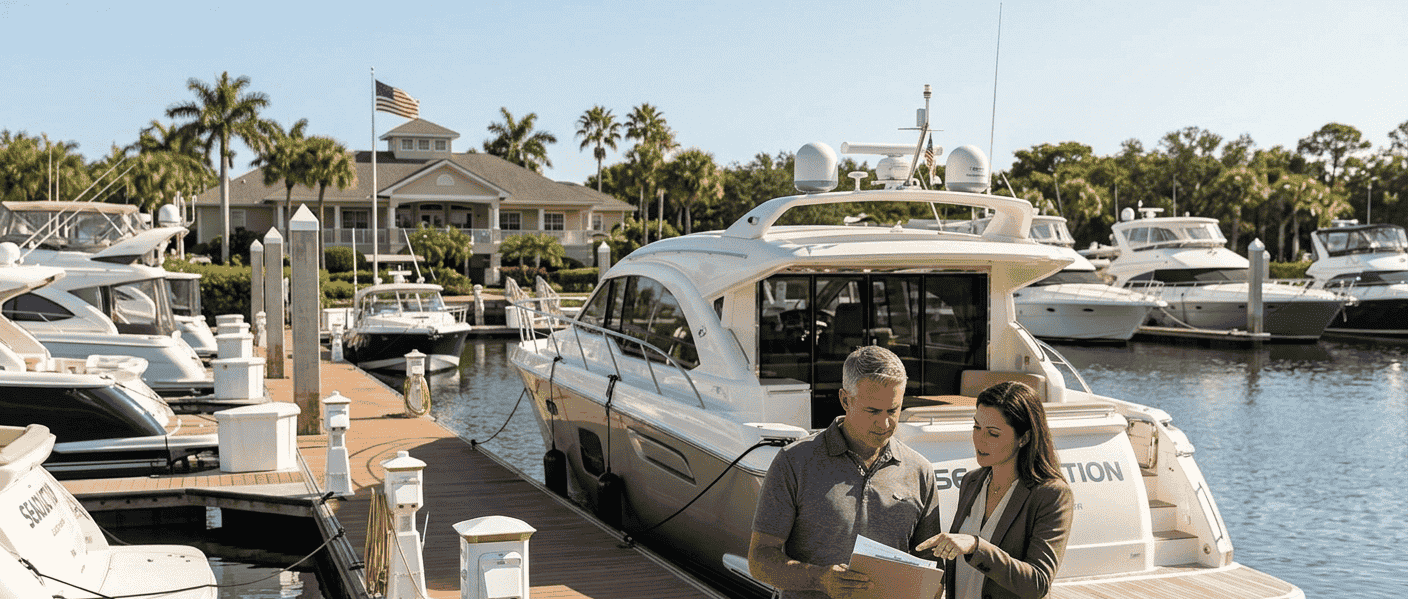
How do you finance a boat slip? It depends entirely on what kind of slip you’re actually buying, and this is the part almost every guide skips. A deeded slip, or dockominium, is real property, and specialty lenders finance it the way a mortgage finances a home, typically with 30 to 50 percent down and a 10 to 15 year term. A rented or membership based slip is not real property, so there’s usually nothing to finance at all, you just pay the marina. Building your own dock on waterfront property you already own is a home improvement project, financed with a personal loan or a HELOC. Get this distinction right first, everything else follows from it.
Key takeaways
- “Boat slip financing” actually covers three unrelated situations. Confusing them wastes time with the wrong lender.
- A deeded or dockominium slip can be financed like real estate, but few conventional mortgage lenders will touch it. You’ll likely need a specialty marine or slip lender.
- A rented, licensed, or membership based slip is a contract right, not property. It generally cannot be mortgaged.
- Building a dock on your own waterfront property is financed with a personal loan or HELOC, not a slip specific product.
- Interest on a deeded slip loan may be tax deductible as second home mortgage interest if the slip qualifies. Confirm with a tax advisor.
First, figure out which situation you’re actually in
Before you call a single lender, answer this question: does the slip come with a deed, or does it come with a lease, license, membership, or rental agreement? The answer determines everything else in this guide.
| Your situation | What you’re really buying | How it’s financed |
|---|---|---|
| Buying a slip with a recorded deed or condo unit (dockominium) | Real property | Specialty slip mortgage, home equity, or cash |
| Buying rights under a long term submerged land lease | A share of a lease, with an expiration date | Sometimes financeable, terms vary widely |
| Renting, licensing, or joining a marina for slip access | A contract right, not property | Usually not financed. You pay as you go |
| Building a new dock or lift on land you already own | A home improvement project | Personal loan, HELOC, or home equity loan |
Scenario 1: Buying a deeded slip or dockominium
What you’re actually buying
A dockominium is created when a marina converts individual slips into separately owned real estate units, similar to how an apartment building converts into condos. Each slip typically gets its own parcel number, deed, tax bill, and share of a homeowners or condo association that maintains the docks, seawalls, and common areas.
Not every “owned” slip is equally solid, though. Real estate attorneys who close these transactions generally sort slip ownership into a small number of categories, roughly in order of how much you actually own:
- Fee simple ownership on privately owned submerged land. The strongest form. You own the land under the water outright, not just a structure on top of it.
- A dockominium or condominium unit. You own the slip as a legally created real estate unit, usually under a state’s condominium statute, with a deed, a parcel number, and an undivided share of common elements.
- A limited common element. The slip is assigned to your home or condo unit under a broader community’s governing documents, rather than deeded on its own.
- A share of a submerged land lease. Many marinas sit on land leased from the state, not owned. You’re buying rights under that lease, which has a term and an expiration date, even if renewal is routine.
- A license, membership, or rental agreement. This is a contract right to use a slip, not ownership of anything. It generally cannot be used as loan collateral.
Only the first three are typically real estate a lender can secure a loan against. If you’re not sure which category a slip falls into, a title search at the county property appraiser or clerk of courts will tell you, and this is worth doing before you fall in love with a specific slip.
What it costs
Dockominium purchase prices commonly range from around $10,000 for a small slip at a modest marina to $200,000 or more for a large slip at a premium coastal marina, with some luxury markets running higher still. On top of the purchase price, expect ongoing HOA or association dues, commonly cited in the range of $100 to $1,500 a month depending on the marina’s amenities, services, and how much deferred maintenance the association is funding.
How it’s financed
This is the part that surprises most buyers. Conventional residential mortgage lenders are built to underwrite houses and condos people live in, and a bare boat slip, with no roof and no living space, generally does not fit that underwriting model. Most conventional lenders simply will not finance one on its own.
Instead, financing usually comes from one of these paths:
- Specialty marine or slip lenders. A small number of lenders specialize in dockominiums and deeded slips. Terms commonly cited for 2026 run around 30 to 50 percent down, 10 to 15 year amortization, and interest rates roughly 1 to 2 percentage points above a conventional 30 year mortgage rate.
- Rolled into a home purchase. If the slip is deeded alongside a residence, such as a waterfront condo with an attached slip or a community where slips are assigned to specific homes, its value can often be financed as part of the home loan itself, rather than as a separate product.
- Home equity loan or HELOC. If you already own a home with equity, borrowing against it is frequently cheaper and simpler than a specialty slip loan, since it uses standard residential mortgage underwriting rather than a marine specific process.
- Seller financing. Some slip owners will finance the sale directly, particularly in smaller or less liquid markets where traditional lenders show little interest. Terms are negotiated individually, so get everything in writing and have an attorney review it.
- Hard money or private lending. For buyers with lower credit or an unconventional situation, private lenders will sometimes lend against a slip’s appraised equity, commonly up to around half its value, at rates well above conventional financing. Treat this as a last resort given the cost.
- Cash. Many dockominium sales, especially at smaller marinas, close in cash simply because financing options are limited or too slow for a competitive market.
The tax angle
Mortgage interest on a deeded slip loan, along with real estate taxes paid on the slip, may be deductible if the slip qualifies as a second home under federal tax rules, and this deduction can sometimes extend to a boat loan as well if the boat itself qualifies as a second home (generally requiring sleeping, cooking, and bathroom facilities aboard). This is a meaningful potential benefit, but the rules are specific and situational. Confirm your eligibility with a tax professional before assuming it applies.
Due diligence before you buy or finance
- Confirm the legal structure. Deeded, dockominium, limited common element, leasehold, or license. Ask for the specific recorded document, not just a verbal description.
- Check the underlying land. If the marina sits on state owned submerged land under a lease, find out the lease’s remaining term and renewal history. A lease nearing expiration can affect both value and financeability.
- Review the association’s finances. Ask for the HOA or condo association’s budget, reserve fund balance, and any history of special assessments. A financially weak association is a red flag for a real estate purchase, exactly as it would be for a condo.
- Confirm insurance requirements. Marine structures carry their own insurance considerations, and a lender will typically require proof of coverage meeting specific minimums.
- Verify physical fit. Length overall, beam, draft, and approach depth at low water all matter, and many buyers are advised to choose a slip a few feet longer than their boat for easier handling.
- Ask about transfer restrictions. Some associations require approval before you can sell or rent out your slip, which affects both resale and any plan to generate rental income when you’re not using it.
Scenario 2: Renting or licensing a slip (usually not financed)
If the slip you’re looking at comes with a rental agreement, an annual license, or a marina membership rather than a deed, there is typically nothing to finance in the traditional sense. You’re paying an ongoing fee, whether monthly, seasonally, or annually, for the right to use the space. Some marinas offer their own payment plans for annual or seasonal slip fees, so it’s worth asking directly, but this is closer to a payment plan than a loan.
This isn’t necessarily a worse option. It carries far less financial commitment and no risk tied to real estate financing, which is exactly why many boaters choose it over ownership, particularly if they’re not certain they’ll stay in one location for years.
Scenario 3: Building a dock or slip on your own property
If you already own waterfront land and want to add a dock, boat lift, or slip structure, you’re financing a home improvement project, not purchasing real estate. This is genuinely a different problem from either scenario above, and it’s the one most “boat slip loan” marketing pages are actually describing, even when their branding suggests otherwise.
What it costs
Costs vary widely by dock type and site conditions:
| Dock type | Typical cost | Notes |
|---|---|---|
| Floating dock (modular sections) | $2,000 to $8,000 | Removable for winter, works with fluctuating water levels |
| Pipe or roll in dock | $3,000 to $10,000 | Common on northern lakes, removed seasonally |
| Fixed pile supported dock | Higher, site dependent | More permanent, often needs a permit |
| Full residential dock with boat lift | $12,000 to $35,000 | Typical total project cost |
| Large custom dock with covered slip, lift, and premium decking | $30,000 to $65,000 | High end residential builds |
Budget meaningfully above a basic quote to account for permitting, marine grade materials, and a lift, since these commonly add 30 to 50 percent to the base structure cost.
How it’s financed
- Personal loan. This is usually the simplest fit, since it requires no collateral tied to the dock or your home, funds quickly, and works whether you’re building a $3,000 floating dock or a $35,000 covered slip with a lift.
- Home improvement loan or HELOC. If you have home equity, this can offer a lower rate than an unsecured personal loan, at the cost of using your home as collateral.
- 0 percent promotional credit card. For smaller projects, a budget floating dock can sometimes fit within a 0 percent introductory credit card offer, provided you can pay it off before the promotional period ends and the trap of deferred interest that follows.
A worked example: a $20,000 dock and lift project financed with a personal loan around 8 percent over 60 months runs roughly $406 a month, with total interest around $4,300 over the life of the loan. Extending to an 84 month term lowers the payment but raises total interest paid, a tradeoff worth running through a loan calculator with your actual numbers before committing.
Putting it all together: your decision path
| Your situation | Start here |
|---|---|
| Buying a slip with a deed or dockominium unit | Ask a specialty marine or slip lender for terms, and compare against a HELOC if you own a home with equity |
| Buying alongside a home purchase where a slip is deeded to the property | Ask your mortgage lender if the slip’s value can be rolled into the home loan |
| Considering a leased, licensed, or membership based slip | Treat it as an ongoing expense, not a purchase to finance |
| Building a dock on land you already own | Compare a personal loan against a HELOC based on your rate and how much home equity you’re willing to use |
| Uncertain which category a slip falls into | Order a title search before you talk to any lender |
Common mistakes to avoid
- Assuming a “boat slip loan” product from a general lender covers a deeded slip purchase. Many of these products are actually personal loans meant for dock construction, not real estate financing for a dockominium unit.
- Skipping the title search. The difference between a deeded slip and a membership that merely feels permanent can be significant, and it’s not always obvious from a listing description.
- Ignoring the ground lease. A slip attached to a marina operating on a submerged land lease nearing its end can lose value even if it looks and functions perfectly today.
- Underestimating HOA dues and reserve health. A slip that’s cheap to buy but sits in a financially weak association can turn expensive fast through special assessments.
- Not asking about insurance requirements upfront. Marine structures often carry different insurance rules than a typical home, and a lender’s requirements can affect your total cost.
FAQs
Only if it’s deeded or structured as a dockominium unit, and even then, most conventional mortgage lenders won’t do it. You’ll typically need a specialty marine or slip lender, or you’ll roll it into a home purchase if the slip is deeded alongside a residence.
Sometimes. A deeded slip or dockominium unit generally is. A rented, licensed, or membership based slip generally is not, and is instead treated as a contract right.
For specialty slip lenders financing a deeded slip, 30 to 50 percent down is commonly cited for 2026, though terms vary by lender and slip type.
Yes, and it’s often one of the more accessible and lower cost options if you already own a home with sufficient equity, since it relies on standard residential underwriting rather than marine specific lending.
Potentially, if the slip qualifies as a second home under federal tax rules and you itemize deductions. Confirm your specific situation with a tax professional before relying on this.
A slip is the water space, essentially a parking spot for your boat. A dock is the physical structure, the pier or platform, that provides access to that space. You can finance building a dock on your own property with a personal loan, while financing a deeded slip is closer to a real estate transaction.
Generally no, in the traditional sense, since you’re not purchasing an asset a lender can secure a loan against. Some marinas offer their own payment plans for seasonal or annual fees, so ask directly.
It depends on the path. Personal loans for dock construction typically want fair to good credit for the best rates. Specialty slip lenders and home equity products generally look for good to excellent credit, given the size of the loan involved.
Bottom line
Start by confirming exactly what you’re buying. A deed or dockominium unit puts you in real estate financing territory, where a specialty marine lender, a rolled in home loan, or a HELOC are your realistic paths. A rental or membership generally isn’t financed at all, it’s simply an ongoing cost. And if you already own waterfront land and want to build your own dock, that’s a home improvement loan, not a slip purchase. Get the category right first, and the rest of the process becomes far more straightforward.
This is general information, not financial, legal, or tax advice. Financing terms, availability, and real estate rules vary significantly by state, marina, and lender. Confirm current details directly before committing.