
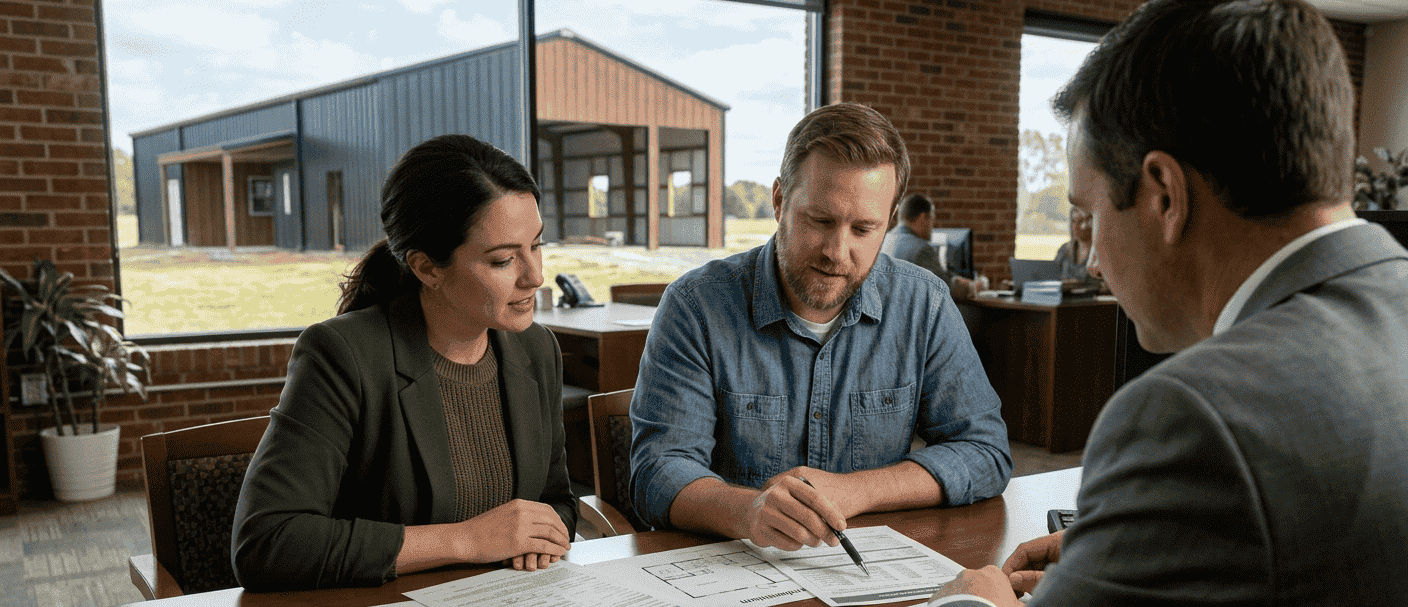
How do you finance a barndominium? Most buyers use a construction-to-permanent loan, which pays for the build in stages and then converts to a regular mortgage. Eligible veterans can use a VA one-time close loan with no down payment. Buyers in USDA-eligible rural areas may qualify for zero down, FHA allows as little as 3.5 percent down, and community banks, credit unions and Farm Credit lenders offer portfolio loans for cases the big programs won’t fit. Federal loan programs do not ban barndominiums. The real obstacles are lender restrictions and appraisals, and both are manageable once you understand them.
Key takeaways
- Nothing in Fannie Mae, Freddie Mac, FHA, VA or USDA guidelines prohibits a barndominium. Many lenders add their own “no metal-frame homes” rules, called overlays, so finding the right lender matters more than finding the right program.
- The appraisal is the main hurdle because barndominiums have fewer comparable sales. VA appraisers need three comparables.
- Typical down payments: $0 for VA and USDA, 3.5% or more for FHA, roughly 15% to 25% for conventional construction loans, and 20% to 30% for portfolio loans.
- If you don’t own land yet, expect a separate hurdle. Raw land commonly requires 30% to 50% down.
- The 30-year fixed mortgage rate averaged 7.03% on September 24, 2026 (Freddie Mac). Construction and barndominium loans usually price above that benchmark.
- Pick your lender before your builder, and protect every payment with inspected draws.
What is a barndominium, and why is it treated differently?
A barndominium, or “barndo,” is a home built with a metal or post-frame structure that often combines living space with a workshop, garage or barn-style area. Buyers like them for their open floor plans, quick shell construction and, in many markets, lower cost per square foot than a traditional home.
Lenders treat them differently for five reasons:
- Few comparable sales. Appraisers value homes using recent sales of similar homes. A rural barndominium may have very few.
- Classification. The Texas Real Estate Research Center notes that many banks do not consider barndominiums a dwelling, which affects loan length and rates.
- Zoning. Many barndominiums sit on rural parcels zoned agricultural or mixed use, and lenders may require the right residential classification before closing.
- Lender familiarity. A lender that has never closed one learns on your file, which adds time.
- Lender overlays. Overlays are extra restrictions a lender adds on top of agency rules. A “no unusual properties” policy can shut out a barndominium even when the program itself allows it.
The practical lesson is that a “no” from one lender is usually not a “no” from the system. It often just means that lender doesn’t do barndominiums.
Step 1: Figure out which situation you are in
| Your situation | Typical path |
|---|---|
| I own land free and clear and want to build | Construction-to-permanent loan, using land equity as part of the down payment |
| I need to buy land and build | Land loan first, or a construction loan that finances lot and build together |
| I want to buy a finished barndominium | A mortgage, if the home is livable and the appraisal has support |
| I built with cash and want a mortgage now | Refinance onto a standard mortgage after completion |
| I want to convert an existing barn or metal building | Hardest case. Zoning, code compliance and appraisal all need early attention |
Step 2: Build a realistic budget before you borrow
Barndominium cost numbers online range from $20 per square foot to over $300, which is why so many first-time budgets fail. The gap is almost always about scope: a steel shell is not a finished home, and a finished home is not the same as land plus site work plus utilities.
| Source (2026) | Reported range | What it describes |
|---|---|---|
| HomeGuide (January 2026) | $65 to $160 per sq. ft. | Finished, professionally built home |
| Steel Structures America (April 2026) | $100 to $200 per sq. ft. | Builder-finished home |
| Modern House Plan Ideas (May 2026) | $120 to $175 per sq. ft. | Finished 2,000 sq. ft. home |
| Barndominiums.com (June 2026) | $150 to $300+ per sq. ft. | Finished home in many markets |
Component costs from HomeGuide’s 2026 data:
- Kit shell erected: $30 to $50 per sq. ft. On 2,000 square feet, that is $60,000 to $100,000 for the structure alone.
- Concrete slab foundation: $6 to $14 per sq. ft.
- Site prep (clearing, grading, well, septic): $20,000 to $60,000 depending on the lot, per HomeCostLab.
- Regional swing: HomeGuide puts Texas at $68 to $168 per sq. ft. and Oklahoma at $62 to $152.
On those ranges, the erected shell is roughly a third to just under half of a finished budget. That is why a kit price alone never gives a lender what it needs. Lenders want a complete plan and cost estimate for the finished home, which K-Construction and other builders confirm.
Add a cushion. Construction always turns up surprises. Ten percent is a common rule of thumb, though your builder and lender can tell you what fits your project.
Your financing options
1. Conventional construction-to-permanent loan
This is the workhorse for most civilian buyers. You close once, the loan funds in stages during construction, and it converts to a permanent mortgage when the home is finished.
- Down payment: commonly 15% to 25% of total project cost. Rural 1st advertises as little as 15% down with no PMI, and says it values acreage and outbuildings in the equity calculation.
- Credit score: many lenders look for 680 or higher, with better pricing at 700 or above. Treat these as lender guidelines that vary.
- Structure: interest-only payments during construction, typically on the amount drawn so far, followed by conversion to a 30-year mortgage.
- Land equity: if you own the lot, its value usually counts toward your down payment.
2. VA one-time close construction loan
Eligible veterans, service members and surviving spouses can finance land, construction and the permanent mortgage in one closing.
- Launch: the VA announced its standardized One-Time Close Construction Loan Program nationwide on August 6, 2025. Before that, construction financing existed in policy but few lenders offered it.
- Builder ID: a March 2025 VA circular removed the requirement that builders obtain a VA-issued Builder ID. The builder must still be acceptable to your lender.
- Terms: $0 down for veterans with full entitlement, no PMI, and a funding fee that can be rolled into the loan. Veterans with service-connected disabilities may be exempt from the fee.
- Requirements: a Certificate of Eligibility, a primary residence, a VA appraisal and Notice of Value, and a finished home that meets VA minimum property requirements on a permanent foundation.
- The catch: VA appraisers need three comparable sales, and barndominium comps are scarce in many markets. Many VA lenders also refuse barndominiums as a blanket overlay. One builder guide notes that most veterans told no on a VA barndominium loan are being refused by the lender, not by the VA. If one lender says no, ask another.
3. USDA construction-to-permanent loan
USDA’s guaranteed rural housing program offers $0 down for buyers within income limits.
- Location: eligibility is determined by property address on the USDA eligibility map, not by zoning. Check your parcel before you commit.
- Fees: a 1% upfront guarantee fee and a 0.35% annual fee, lower than FHA’s mortgage insurance.
- The catch: not every lender offers USDA financing, and USDA construction loans are harder to find still. Some barndominium lenders do not offer it at all.
4. FHA one-time close construction loan
FHA’s construction-to-permanent program serves buyers who need flexible credit or a low down payment.
- Down payment: 3.5% with a 580 score, or 10% with a score of 500 to 579.
- Insurance: an upfront mortgage insurance premium of 1.75% plus an annual premium that runs about 0.50% to 0.75% depending on the loan.
- Rules: the borrower must use a licensed general contractor. HUD’s guidance limits a borrower acting as their own builder to narrow circumstances.
- The catch: not every FHA lender will close a barndominium construction loan.
5. Portfolio, community bank, credit union and Farm Credit loans
Portfolio loans are held by the lender instead of being sold to Fannie Mae or Freddie Mac, so the lender sets its own rules. This is where many barndominium loans actually close.
- Community banks and credit unions often know local builders, appraisers and markets.
- Farm Credit associations lend on rural property, and some have home loan divisions offering construction-to-permanent programs for barndominiums.
- Specialty barndo programs: First Federal advertises a nationwide program with interest-only payments for the first 12 months of construction and, in some cases, allows owner-builders.
- Non-QM loans use flexible qualification, such as bank-statement income for the self-employed, usually at higher rates.
- Terms: portfolio down payments typically run 20% to 30%, rates run 1 to 3 points above conventional, and closings can be faster.
6. Financing land first
If you don’t own land, this is often the hardest step.
| Land type | Typical down payment |
|---|---|
| Raw land | 30% to 50% |
| Unimproved lot (some utilities) | 20% to 30% |
| Improved lot (utilities and road access) | 15% to 25% |
Rates in 2026 sources run from the mid single digits to about 11%, with raw land at the top, and terms are often 10 to 20 years, sometimes with a balloon payment. Rural options include local agricultural banks, credit unions, Farm Credit, and seller financing, which may require 10% to 30% down at negotiated rates.
The trap: land equity only helps your construction down payment if you actually have it. Say you buy $80,000 of raw land with 40% down, or $32,000. Your build costs $350,000, so the total project is $430,000 and 20% is $86,000. Your land equity leaves a $54,000 gap. Ask lenders about a combined lot-plus-construction loan before you buy land separately, and ask how they credit land equity.
7. Two-step: build, then refinance
Some buyers finance the build with a short-term construction loan, a HELOC or cash, and then refinance into a 30-year mortgage. Black Rock Mortgage notes this is one of the most common barndominium requests it sees. The risks are having to qualify a second time and facing higher rates when the build ends. The home must also be finished and livable for the appraisal.
8. Buying an existing barndominium
A conventional loan is possible for an existing barndominium as a primary home, investment property or second home, typically on a 30-year term. Down payments as low as 3% to 5% are possible for a purchase or refinance, unlike construction loans. The appraisal still needs comparable sales, and the home must be complete.
Compare the options at a glance
| Loan | Down payment | Typical credit floor (lender-dependent) | Best for | Watch out for |
|---|---|---|---|---|
| Conventional construction-to-perm | 15% to 25% | 680+ | Most civilian buyers | Higher down payment, appraisal risk |
| VA one-time close | $0 | Around 620+ | Veterans with full entitlement | Lender overlays, three comps |
| USDA construction-to-perm | $0 | Around 640+ | Rural, income-eligible buyers | Few lenders, address and income limits |
| FHA one-time close | 3.5% to 10% | 580+ (500+ with 10% down) | Lower credit, low cash | Mortgage insurance, licensed GC required |
| Portfolio / community bank | 20% to 30% | Varies | Complex files, fast closings | Higher rates, shorter terms |
Credit minimums are commonly reported lender standards, not agency rules, and they change.
How a construction loan actually works
- You close once (single-close) or twice (two-time close).
- The lender releases money in draws tied to milestones such as foundation, framing and rough-in, commonly four to six draws.
- An inspector verifies progress before each draw. The Texas Real Estate Research Center recommends encouraging draw inspections and asking for itemized expense lists.
- You pay interest only on the amount drawn during construction.
- After a final inspection and certificate of occupancy, the loan converts to your permanent mortgage.
What construction interest costs
Because the balance grows as money is drawn, the average balance during construction is often about half the loan. Illustrative math on a $350,000 loan at 8%:
- 8-month build: $350,000 × 50% × 8% × 8/12 is roughly $9,300 in interest.
- 12-month build: roughly $14,000.
Lenders may fund an interest reserve for this, and some builders cite higher reserves, so ask each lender exactly how it is calculated. Delays cost real money, so ask about extension fees.
Worked examples
Illustrative numbers. Your terms will differ, and PMMS rates describe conforming loans with 20% down and excellent credit. Construction and barndominium loans usually price higher.
Example A: You own the land
- Land value: $100,000 (free and clear). Build contract: $350,000. Total project: $450,000.
- Twenty percent of the project is $90,000. Your land equity is $100,000, or about 22%, so it can cover the down payment.
- Loan: $350,000. At an illustrative 7.25% on a 30-year term, principal and interest is about $2,390 a month.
Example B: You need land
- Improved lot: $80,000. Build: $350,000. Total: $430,000.
- Financed as a combined project with 20% down, you need about $86,000 in cash. Bought separately as raw land, you may need $32,000 down now and still face a gap when the construction loan starts.
Example C: Fees on a $350,000 loan
| Program | Upfront fee | Ongoing insurance or guarantee |
|---|---|---|
| VA (first use, under 5% down) | 2.15%, about $7,525 (waived for some disabled veterans) | None |
| USDA | 1%, $3,500 | 0.35% a year, about $102 a month |
| FHA | 1.75%, about $6,125 | About $146 to $219 a month at 0.50% to 0.75% |
Upfront fees can often be rolled into the loan, which raises the balance.
Winning the appraisal
Appraisers need comparable sales, and barndominiums have fewer of them. Ways to improve your odds:
- Provide a complete specification sheet listing every finish category.
- Give the appraiser a cost breakdown by material and labor.
- Show completed comparable builds by the same builder, with photos.
- Ask for a barndominium-experienced appraiser. If your appraiser has never valued one, ask whether another can be assigned.
- Expect a longer timeline. One builder estimates three to five weeks versus one to two for a typical home.
- Know what counts as a comp: other finished, sold barndominiums nearby, or custom homes on similar acreage. Raw land and manufactured homes do not support the value.
Choose your lender first, then your builder
Many barndominium projects stall because the builder was chosen first and the lender then refused the file.
Ask lenders:
- Have you closed a barndominium construction loan in my state, and how many recently?
- Do you have any overlay on metal, steel or post-frame homes?
- Is your loan single-close? When does the rate lock?
- How do you value my land toward the down payment?
- How many draws are there, and what do inspections cost?
- What happens if construction runs long?
- Do you limit acreage, outbuildings, shop size or business use?
- Do you allow owner-builders?
Ask builders:
- What are your license, general liability, workers’ compensation and builder’s risk coverages?
- Can I visit completed barndominiums and speak to those owners?
- Will you provide a fixed-price contract and full specifications?
- How do you support the appraisal?
- How do you handle lien waivers from subcontractors?
- What warranty do you provide?
Protect your money
A Star-Telegram report described a couple who hired a barndominium contractor and, nine months later, had only a 2,000-square-foot slab and were out about $40,000 after the builder stopped responding. The report also noted that barndominium customers often pay cash because many banks won’t finance them. A UT Arlington finance professor called for reforms to hold bad-faith builders accountable.
A lender-run draw process is a built-in safeguard, so if you pay cash or use a HELOC, replicate it yourself:
- Pay for completed, inspected work, not promises. Verify deliveries and progress before each payment, as the Texas Real Estate Research Center advises.
- Request itemized invoices for materials and subcontractors.
- Use lien waivers where your state does, so subcontractors can’t lien your property after you’ve paid the builder.
- Verify the builder’s license and insurance with your state licensing board.
- Avoid large upfront deposits.
- Consider a third-party escrow or title-company draw process.
Zoning, permits, utilities and insurance
- Zoning: some cities prohibit steel buildings, which is one reason barndominiums cluster in rural areas. Confirm with your county before buying land.
- Permits: building, zoning, septic, electrical and mechanical permits are generally required.
- Site factors: the Texas Real Estate Research Center recommends checking road access, drainage, elevation, power access and whether you need septic or city sewer.
- Insurance: get homeowners quotes for a metal-frame home early, and confirm builder’s risk coverage during construction. Corrosion and severe-weather risks are worth researching for steel structures.
Taxes
IRS Publication 936 generally lets you treat a home under construction as a qualified home for up to 24 months, if it becomes your qualified home when ready for occupancy. That can make construction-period interest potentially deductible if you itemize. Confirm your situation with a tax professional.
Common reasons barndominium loans fall through
- The appraisal comes in low or lacks comps.
- The lender has an overlay against metal or unique properties.
- Agricultural zoning conflicts with residential use.
- The builder is not acceptable to the lender.
- The land equity doesn’t cover the down payment.
- The budget only includes the kit.
- A large attached shop or business use complicates eligibility.
If you are denied
Try a different lender type before changing your plan: a community bank, credit union, Farm Credit association or portfolio lender. Add a larger down payment, supply stronger appraisal support, or switch to a builder the lender already knows. If you’re a veteran, apply with a second VA lender. If none of that works, a phased cash build followed by a refinance may still get you there.
Step-by-step roadmap
- Gather documents: two years of tax returns, pay stubs, bank statements, and a VA Certificate of Eligibility if applicable.
- Set a full budget including land, site work, utilities, permits, and a cushion.
- Find a barndominium-experienced lender and get pre-approved.
- Check zoning and USDA eligibility for your parcel.
- Select a builder and finalize plans, specifications and a fixed-price contract.
- Apply, appraise, underwrite and close.
- Build with inspected draws.
- Complete the final inspection, obtain the certificate of occupancy, and convert to your permanent mortgage.
FAQs
Yes. Agency guidelines allow them, but many lenders add their own restrictions, so you need a lender with experience.
Some do. Community banks, credit unions, Farm Credit associations and portfolio lenders are the most common sources.
It depends on the program and lender. Commonly reported minimums are around 620 for VA, 640 for USDA, 580 for FHA and 680 for conventional, but they vary.
$0 for VA and USDA, 3.5% or more for FHA, 15% to 25% for conventional construction loans, and 20% to 30% for portfolio loans.
Yes, if the home is a primary residence on a permanent foundation and meets VA property requirements. Lender overlays and appraisal comps are the main obstacles.
Yes. VA and USDA allow land in the total loan, and some lenders offer combined lot-plus-construction loans.
Some lenders allow it, such as First Federal’s program, but many programs do not. FHA generally requires a licensed general contractor.
Mortgage lenders generally lend on completed, livable homes, so shell-only projects usually rely on cash or short-term financing.
Not automatically. Comparable sales, finish quality and documentation drive the result.
Yes, once the home is finished and livable, and the appraisal has support.
Potentially, for up to 24 months under IRS rules, if the home becomes your qualified residence. Consult a tax professional.
Bottom line
Financing a barndominium is realistic when you match the loan to your situation. Start with the budget, then find a lender that has closed barndominium loans. Own land? Use it as your down payment. Veteran? Look at the VA one-time close program. Rural and income-eligible? Check USDA. Need flexibility? Ask community banks, credit unions and Farm Credit. Whatever you choose, get the appraisal support in place early and protect every payment with inspected draws.
This is general information, not financial, legal or tax advice. Programs, rates and lender rules change and vary by state. Confirm current terms with a licensed mortgage professional before you commit.