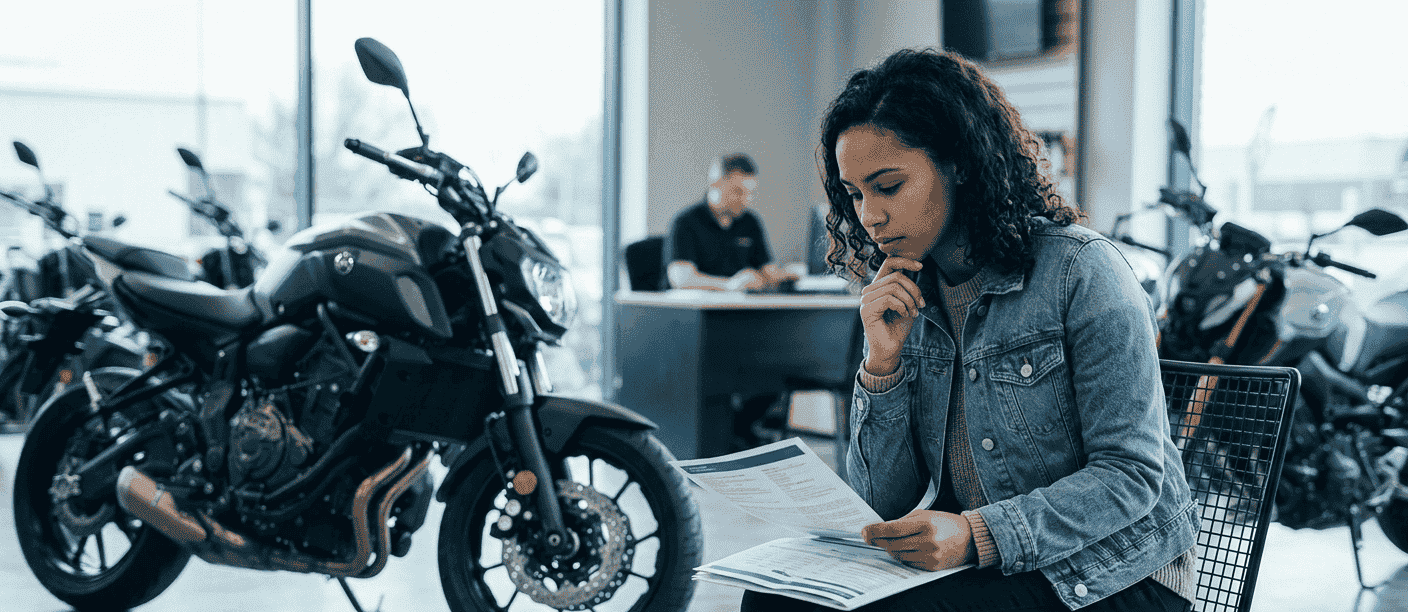
Can you finance a motorcycle without a license? Usually yes, for the loan itself. Most lenders care about your credit and income, not whether you can legally ride. But “license” means three different things here, a driver’s license (ID), a motorcycle endorsement (permission to ride), and insurance eligibility (which usually requires the endorsement), and mixing them up is where people get stuck.
Key takeaways
- Financing needs a government-issued ID, not necessarily a motorcycle endorsement.
- Riding on public roads without an endorsement is illegal everywhere, and it’s genuinely dangerous: NHTSA found 34% of motorcyclists in fatal 2023 crashes had no valid motorcycle license.
- Insurance is the real bottleneck. Most insurers want to see an endorsement or at least a learner’s permit before writing a policy, and most lenders require insurance.
- One legal, license-free path exists: an off-road-only bike ridden on private land.
- A learner’s permit, a named licensed rider on your policy, or delayed delivery can all work as interim solutions.
Three separate questions, one confusing phrase
| Question | Who cares | Typical answer |
|---|---|---|
| Do I need ID to apply for financing? | The lender | Yes, a state ID, passport, or driver’s license. Not necessarily a motorcycle endorsement. |
| Do I need a motorcycle endorsement to get approved? | The lender | Usually no. A few small credit unions ask for one; most banks, credit unions, and dealer lenders don’t. |
| Do I need an endorsement to legally ride it? | Your state, and your insurer | Yes, always, to ride on public roads. And insurers generally want one before they’ll write a policy. |
What lenders actually check
Motorcycle lenders underwrite the loan, not your riding ability. Expect them to look at:
- Credit score. A FICO score of 670 or higher is generally considered “good” and opens up meaningfully better rates.
- Income and debt-to-income ratio, typically capped around 43%.
- Proof of identity, a driver’s license, state ID, or passport. Sheffield Financial’s own dealer program guidelines confirm this is an identity-verification step, not a license check.
- A down payment, commonly 10–20% of the price.
Some dealer pre-approval tools go even further: certain Harley-Davidson dealer “quick pre-approval” pages explicitly skip the driver’s license number for the initial soft-pull step, checking it only later if you move forward.
What rates and terms actually look like
Illustrative ranges, not a quote. Your actual rate depends on the lender and your credit file.
| Lender type | Example | Typical rate range | Notes |
|---|---|---|---|
| Unsecured personal loan | LightStream | 6.99%–13.89% APR with AutoPay | Needs good-to-excellent credit (roughly 660+); no motorcycle-specific requirement |
| Dealer/manufacturer financing | Harley-Davidson Financial Services, Sheffield Financial | Varies by credit tier | Checks ID, income, credit, not an endorsement |
| Credit union | Varies | Around 6%+ for strong credit | A handful may prefer an endorsement; ask directly |
| Bad-credit tier | Various | 30%+ APR | Available, but expensive; a bigger down payment helps |
Loan terms typically run 36 to 84 months.
The real obstacle: insurance, not the loan
If you’re financing, your lender will almost certainly require comprehensive and collision coverage to protect their collateral, more than the minimum liability coverage your state requires for road use. That’s where a license issue actually bites:
- Many insurers won’t write a motorcycle policy without a valid endorsement.
- Some will insure a learner’s permit holder, usually with a higher premium and restrictions (daylight-only, no highways, no passengers, depending on your state’s permit rules).
- A few insurers let you name a licensed household member as the primary rider, using their driving record for pricing. Only that named person is covered to ride it.
If insurance lapses: what force-placed coverage costs you
Financed vehicles almost always carry a continuous-insurance clause. If you never get coverage, or it lapses, the lender can add force-placed insurance and bill you for it. This is standard for auto-secured loans generally; the 45-day notice rule specifically comes from CFPB mortgage regulations, but auto and motorcycle lenders use similar contract clauses.
| Your own policy (with endorsement) | Force-placed (lender-arranged) | |
|---|---|---|
| Covers you personally | Yes | No, only the lender’s collateral interest |
| Typical cost | Market rate for your risk profile | Often several times higher |
| Who pays | You, directly | Added to your loan balance, raising your payment |
| Risk if unpaid | Normal late-payment consequences | Can trigger an acceleration clause and repossession |
This is the chain that trips people up: no endorsement → can’t get a standard policy → lapsed or force-placed coverage → higher payments → repossession risk. It’s rarely the loan approval itself that fails.
The one path that’s genuinely license-free: off-road-only bikes
If your actual goal is “own a motorcycle without dealing with licensing yet,” an off-road-only or OHV-titled bike used on private land is the cleanest legal route:
- No state requires a driver’s license or motorcycle endorsement to ride on private property with the owner’s permission.
- These bikes ship without street equipment (headlight, turn signals, mirrors, DOT tires) and are often titled “off-road only.”
- Registration, not licensing, is usually the requirement for public OHV trails and parks and rules vary by state. Some states also require riders 16+ to hold a valid driver’s license (not a motorcycle endorsement) to use public OHV trails.
- You still need a government ID to title, register, or finance one, the license-free part applies to riding it, not buying it.
This won’t work if your goal is a street bike you plan to ride on roads soon. But if you’re financing now and licensing later, it removes the insurance bottleneck entirely, since liability insurance generally isn’t required for private off-road use.
Why the endorsement matters beyond paperwork
NHTSA’s 2023 data found that 34% of motorcycle riders in fatal crashes had no valid motorcycle license, compared with 15% of car drivers in fatal crashes, a gap NHTSA’s 2024 data put at 35%. That gap points to a real training deficit, not just a legal technicality. A Motorcycle Safety Foundation Basic RiderCourse is the fastest route to an endorsement in most states, many states waive the road test, and some waive the written test, for graduates and insurers often discount for it.
Your decision path
| Your situation | What to do |
|---|---|
| No license or ID at all | Get a state ID first, you need this for financing regardless. |
| Have a driver’s license, no motorcycle endorsement | You can likely get financed. Start the MSF course now; ask your insurer about learner’s-permit or restricted policies. |
| Have a learner’s permit | Call insurers directly, some will write a restricted policy. Confirm terms before you finalize the loan. |
| Want to ride today, not in a few weeks | Get the endorsement first. It typically takes a few weeks and removes every downstream problem. |
| Just want to own something now, ride later | Consider an off-road-only bike for private land, and get licensed on your own timeline. |
| A licensed household member will ride it | Ask insurers about naming them as primary operator, check what that does and doesn’t cover you for. |
Buying with cash instead
Paying cash sidesteps the lender’s insurance requirement, but not your state’s. Some states (Florida is a commonly cited example) don’t mandate motorcycle liability insurance, though it’s still strongly recommended. Registration still generally requires proof of insurance or an ID in most states – verify your state’s current rule before assuming you can skip it.
FAQs
Usually no. Lenders check credit, income, and identity, a government-issued ID, not necessarily an endorsement.
No. Bring a licensed friend or family member to evaluate the bike for you.
Sometimes, with a higher premium and riding restrictions. Ask insurers directly, since this varies by company and state.
You likely can’t get standard insurance, which usually triggers your lender’s force-placed insurance and raises your payment. Riding without an endorsement is illegal in every state.
Yes for financing (you still need ID). Yes for riding on private land, no license needed anywhere. Public trails often require registration and sometimes a driver’s license, depending on the state.
No. In most states it’s an endorsement (often an “M” class) added to your existing driver’s license, not a separate document.
Bottom line
You can almost always get financed without a motorcycle endorsement — lenders care about repayment, not riding skill. The real constraint is insurance, which most insurers won’t issue without one. If you want to ride soon, get your endorsement before you shop. If you just want to own the bike now, either accept a learner’s-permit policy with restrictions or buy an off-road-only bike for private land while you get licensed.
This is general information, not legal, financial, or insurance advice. Rules vary by state and lender, so confirm current requirements before you buy.